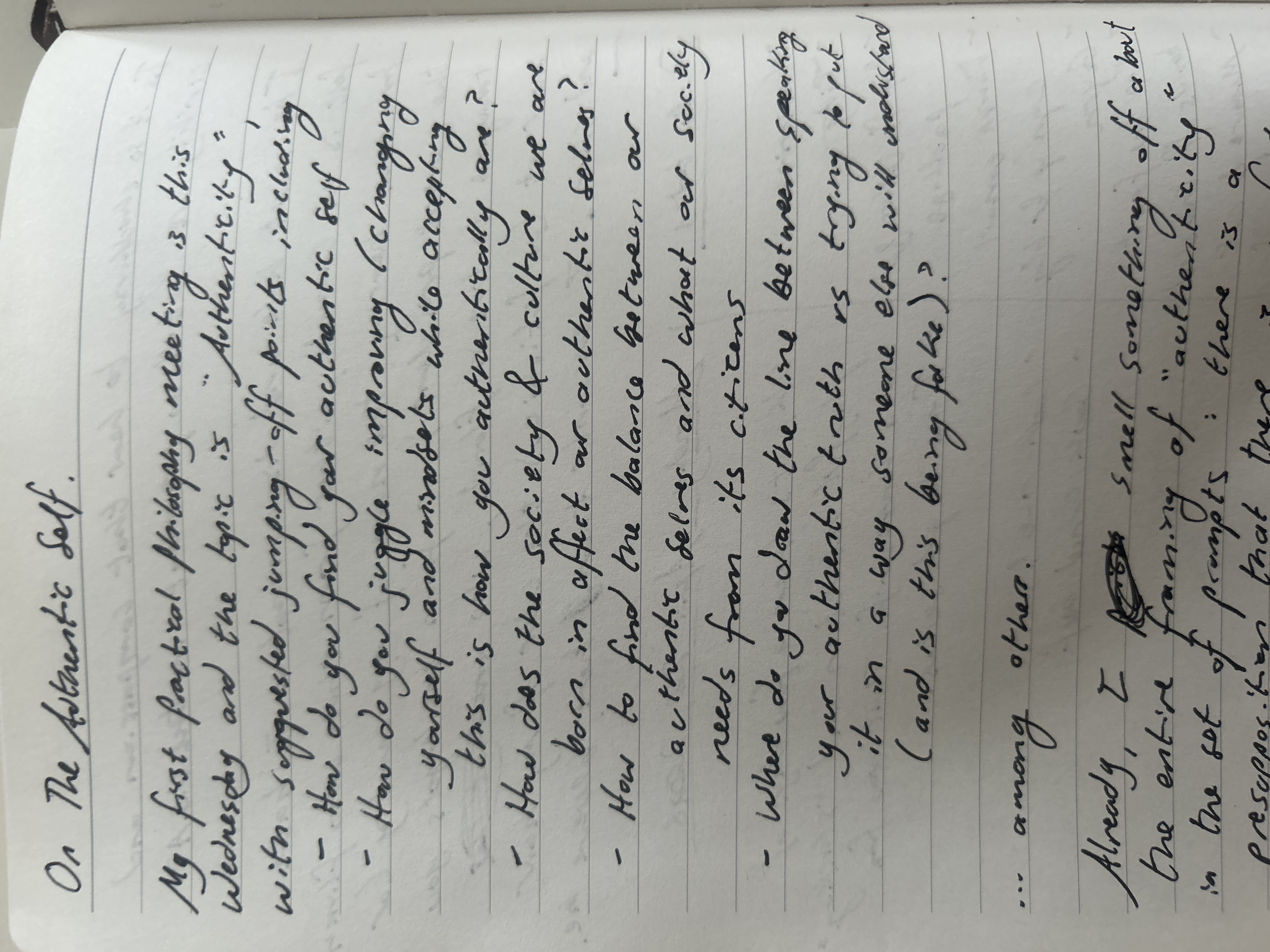
(Straight from my journal)
On The Authentic Self
My first Practical Philosophy meeting is this Wednesday and the topic is “Authenticity”, with suggested jumping-off points including:
•	How do you find your authentic self

•	How do you juggle improving (changing yourself and mindsets) while accepting this is how you authentically are?

•	How does the society & culture we are born in affect our authentic selves?

•	How to find the balance between our authentic selves and what our society needs from its citizens

•	Where do you draw the line between speaking your authentic truth vs trying to put it in a way someone else will understand (and is this being fake)?
… among others.
Already, I can smell something off about the entire framing of “authenticity” in the set of prompts: there is a presupposition that there is, in fact, a “core authentic self” that one either already has or must aspire towards.
This bothers me immensely.
Maybe it’s the a deluge of articles, books, and podcasts I encountered during my business studies that all laude “being authentic in the workplace” or “bringing your ‘true self’ to your leadership role” that hardened me to the idea of celebrating authenticity, but I have come to the resolute conclusion that chasing authenticity is a trap. This even extends to chasing authenticity in cuisine (eg “authentic Chinese food”) and in art.
Consider how authenticity functions in the world of objects. A vintage Hermès scarf, beautifully made, would plummet in value the moment it was revealed to be inauthentic - even if the craftsmanship were identical to the genuine article. Nothing changed but the narrative of its existence.
Is what we call “authenticity” a narrative, and are people viewing things that fall outside of that narrative as inauthentic? Is it so difficult to change a narrative to include the “inauthentic” parts? Surely it’s at least a part of the whole. I’ll go into the importance of narratives in a future entry, I think.
If this is true of objects, why would the self be different?
The “self”, perhaps, is a shifting collection of roles, adaptations, and narratives, as Meredith Brooks so eloquently puts it in her 1997 song “Bitch”: “I’m a bitch, I’m a lover, I’m a child, I’m a mother, I’m a sinner, I’m a saint, I do not feel ashamed”.
Perhaps a classical example would help. The Ancient Greek gods were not simply “their core authentic selves” all the time; they all had various jobs/personas/representations called “aspects” that they would embody at different times depending on the relationship or situation. I mean, Persephone is simultaneously the queen of the dead and the goddess of spring renewal. Apollo is the god of both healing and plague. The gods were approached from specific angles to meet specific needs.
Hindu mythology is full of more extreme examples, such as Vishnu having 10 primary avatars (and other lesser ones), where each one is genuinely Vishnu and not a kind of mask over an “authentic” version of Vishnu. All of this talk about gods to say that the idea of multiplicity being natural (and even divine!) is an old concept. But such things can be lost in as little as 3 generations.
I came up with a metaphor for myself that works well to resolve the dissonance produced when I catch myself creating a hierarchy out of my “parts” (or masks or whatever you want to call them). I like to imaging myself (vainly) as a beautiful, sparkling cut diamond, where every facet glitters in its own way. To look at the diamond from only one angle and say “This facet of this diamond is the real diamond” would be foolish, no?
The version of you that exists in a job interview isn’t fake, and neither is the version of you that hangs out with group A friends instead of group B friends. Business Alex, Party Alex, Big Sis Alex, and Adventure Alex are all different and all real. Each version is just as “authentic” as the others.
Treating one of these as the “real” self and the others as performances creates a false hierarchy - and worse, it creates an imaginary gap between who you are and who you think you should be. That gap produces anxiety, and who needs more of that these days?
And then on performing authenticity to others. There is an immense pressure to “be your true empowered self” out there, whether it’s in the work place or social media, but is this the wisest course of action? I think not.
I learned this early in my youth when I played competitive online games. Rather than being authentic and putting it out there that my team was playing with a college girl (a real sticking point at the time), I would pretend that I was a younger boy who’s voice didn’t drop yet. It was only after I proved my competence to the team that I considered it safe to be “authentically my true empowered self”, (i .e. a g*mer girl).
A more modern example is my hesitation to put my pronouns on casual and professional social platforms. I simply do not feel the need to share, and my pronouns are very traditional. You can even consider the practical points that my name, Alex, is gender neutral, which can sometimes help land job interviews.
Imagine if I were queer or something. Why would I want to put my sexual preferences out there? And yet I see that pressure to do so all the time. Sure, it’s celebrated sometimes, but being any kind of different still attracts dangerous attention. Sometimes not being authentic is a matter of safety.
In the Philippines, if I were my authentic American self I would become a target for scammers. Best to keep my mouth shut and let my appearances and actions do the talking.
I think it was Aristotle that said something along the lines of “we are what we repeatedly do” and “excellence is a habit”. I like how the weight of one’s Self is placed on one’s actions rather than core unchanging attributes.
And the Buddhists describe a river that’s always changing, but is still the same river.